The Best Film Conversation Starts with a Question
A film conversation built around open questions helps viewers discuss specific scenes, handle disagreement and hear what another person noticed.
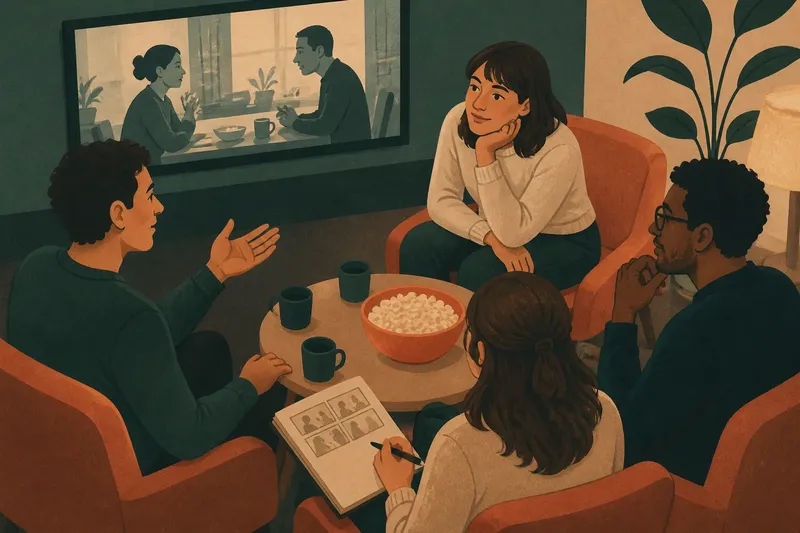
A film conversation becomes more useful when it starts with a question about a particular scene, not a quiz about who remembers the plot. One open prompt gives each viewer room to describe what they noticed before anyone declares what the film means.
Keep the exchange close to the screening itself: invite an immediate response, ask for the scene behind it, then let different readings stand. The aim is not to produce a shared verdict. It is to hear how the same film gave viewers different things to attend to.
How do you start a film conversation?
Ask a question that can be answered from the viewer’s own experience. “What are you still thinking about?” works because it can lead to a sound, a gesture, an image or a feeling. “Did you understand the ending?” tends to make the exchange sound like an examination, which is rarely improved by snacks.
Then ask for a concrete detail. If someone says the film felt tense, ask which moment created that feeling. A pause, a shift in the soundtrack or an actor’s expression gives the conversation something to examine without requiring anyone to defend a complete interpretation.
Say you and a friend have just watched a quiet family drama. You ask what stayed with each of you; your friend names a joke at dinner, while you recall the silence after it. You each point to that scene and explain your response. The resulting discussion concerns a shared moment and two distinct impressions, rather than a contest to identify the correct one.
Which questions keep the discussion open?
Open questions invite more than one reasonable answer and give people room to refer to what they saw or felt. Use a factual question when a plot detail needs clearing up, but avoid stacking them until the chat resembles an oral exam.
- Check whether a scene changed in mood; if viewers name different turning points, ask what each noticed there, and if nobody can identify one, move to a different scene.
- Check how people responded to the ending; if their reactions differ, ask which detail shaped each response, and if the ending is not on their minds, ask what is.
- Check which character was difficult to read; if viewers point to different motives, compare the moments behind those readings, and if no character stands out, ask about a particular performance instead.
- Check what the music added to a scene; if someone noticed a change, ask how it affected the moment, and if they barely noticed the score, turn to sound or silence instead.
- Check whether anyone remembers a specific plot detail differently; if the film itself settles the question, clarify it and return to the response, and if it remains ambiguous, leave both memories in play.
- Check whether one person is dominating the exchange; if so, invite another viewer to name a detail, and if everyone is waiting for a prompt, choose one scene and ask what each person noticed.
These prompts do not rule out judgement. Someone can dislike a performance or admire the ending. Ask what in the film led to that view; the detail is more useful than a verdict floating free of the scene.
What can you ask when viewers disagree?
What if someone disliked a film you admired?
Ask which part lost them and what they hoped the film would do instead. That makes room for preference without requiring either person to defend their taste as a universal principle.
What if one person knows more about film?
Invite them to describe a detail they noticed, then ask how it affected their viewing. Knowledge can add context, but it need not set the difficulty level for everyone else.
What if the conversation stalls?
Choose a specific moment and ask whether anyone wanted it to last longer, end sooner or change direction. A focused prompt is easier to answer than a demand for a complete interpretation.
What if you remember a scene differently?
Separate what the film showed from what each viewer remembers feeling. If the factual detail matters, check the scene together; if it does not, ask why that version stayed with each of you.
How can a film conversation stay focused?
Use one scene as an anchor when the conversation starts to drift. A quiet exchange in a kitchen, a sudden cut or a repeated gesture can bring abstract claims back to something everyone watched. Like putting a bookmark in a book, the scene marks a place without insisting that everyone read it the same way.
If a viewer brings in a review or programme note, ask what specific context it adds to the scene under discussion. Keep the conversation on how that detail changes—or does not change—what the group noticed. The outside opinion is useful only if it opens a question, not if it settles the room by reputation.
A film conversation does not need to cover every scene or reach agreement. A precise prompt, a remembered detail and a little room for disagreement are enough to make the exchange worth having. When it is time to leave, let the last useful question remain unanswered; not every film needs a committee report.