From Souvenir to Memory: Why Film Keepsakes Matter
Film keepsakes can prompt vivid personal recollection without pretending to preserve a film; learn how to choose, annotate and revisit them thoughtfully.
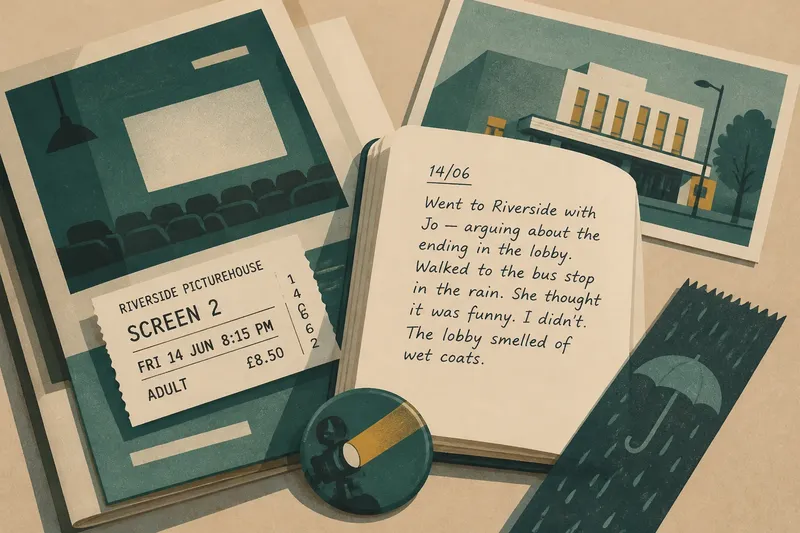
A film keepsake can bring back the evening around a film more clearly than the film itself. A ticket stub, a folded programme or a note on the back of a postcard may recall who sat beside you, what the street looked like afterwards, or the conversation that stayed on the walk home. Film keepsakes matter as prompts for personal memory, not as miniature records of what appeared on screen.
To use one well, begin with the memory you want to keep, choose an object connected to that occasion, and add just enough context for your future self. The object is a bit like a key: useful because it opens a door, not because it contains the room.
What do you want the keepsake to bring back?
Before collecting anything, name the kind of recollection you hope to revisit. It might be the first time you saw a particular film, a screening shared with a friend, or the odd pleasure of watching something alone on a rainy afternoon. A specific intention makes it easier to choose a useful object and less tempting to keep every scrap of paper within reach.
Keep the focus on your experience rather than trying to make a complete record of the film. A programme can tell you what was screened; it cannot tell you why you were tired, what your friend whispered before the lights went down, or why the ending followed you home. Those details belong to your memory and may be worth writing down in their own right.
Say you leave a neighbourhood cinema after seeing a film with your cousin. You keep the paper ticket because it reminds you of the cramped lobby and your cousin’s argument about the final scene. If you add a brief note about the argument and the walk to the bus stop, the ticket becomes a prompt to those particular moments, rather than a claim that it preserves the film.
Which object has a real connection to the occasion?
Choose something you actually encountered during the viewing or its surrounding ritual. Common options include:
- A ticket stub: a simple reminder of a particular visit, especially if you can still place the cinema.
- A programme or handbill: useful for recalling an event, venue or screening series.
- A postcard or printed image: a portable cue if it was bought, given or handled in connection with the occasion.
- A personal note: a scrap of paper recording a thought, conversation or detail you did not want to lose.
- A small, non-paper object: perhaps a bookmark used on the way there or a badge picked up at a screening, if it genuinely belongs to the memory.
Connection matters more than rarity or official status. An ordinary ticket from an unremarkable evening may prompt a stronger recollection than an expensive collectible from an event you barely remember. Avoid choosing an item simply because it looks like it ought to be important.
If you have no physical object, do not manufacture a keepsake by buying something unrelated and assigning it meaning afterwards. A short written note, saved as a dated file or in a notebook, can do the same prompting work. The point is to give memory a handle, not to build a display case.
How should you add context without rewriting the past?
Write a small note while the occasion is still easy to place. Keep it concrete and personal: where you were, who was with you, what happened before or after, and one detail you might otherwise forget. A few lines are often more useful than an elaborate account, which can turn an easy recollection into an administrative duty.
Separate what you remember seeing from what you remember feeling or doing. For example, “The lobby smelled of wet coats” describes a remembered setting; “I thought the final scene was funny” records a reaction. If your memory of a detail is uncertain, say so. A keepsake should invite recollection, not encourage you to fill gaps with invented certainty.
Do not use the object as evidence of the film’s meaning or as a substitute for watching it. The ticket does not establish what happened on screen, and your note is not a neutral account of what everyone in the room thought. It records a point of contact between a film and one particular moment in your life.
How can you store and revisit film keepsakes?
Give the item a home you can find again. Paper tickets and programmes are better kept flat in a folder or envelope than left in a pocket, where they may be bent, lost or mistaken for something destined for the laundry. Group items by occasion, venue or companion—whichever arrangement makes the memory easiest to retrieve.
Keep the note with the object, or make a clear reference between them. A short label such as “Friday screening with Jo” is more helpful than a vague mark that makes sense only to you today. If you keep digital notes, use a filename that names the occasion and store any image of the keepsake alongside the text.
Revisit the collection occasionally, but do not demand a full recollection from each object. One ticket may bring back a lively scene; another may produce only a faint sense of the evening. That unevenness is normal. The object is an invitation, not a memory machine with a customer-service desk.
What questions help you choose a keepsake?
Does a ticket stub preserve the film?
No. It can help you recall attending a screening, but it does not capture the film or establish what you remember about it. Add a personal note if you want to keep a thought or circumstance connected to that visit.
Should you keep every programme and handbill?
No. Keep the ones tied to occasions you may want to revisit, or that carry a specific personal association. Letting go of duplicate or unconnected paper can make the meaningful items easier to find.
What if you cannot remember why you saved an object?
Look for a reliable clue, such as a note, a name or an event written on it, and avoid guessing beyond what you can support. If no connection returns, you can keep it as an unexplained item or release it without treating that choice as a judgement on the film.
Can a digital photograph work as a film keepsake?
Yes, if it points back to a real occasion and you add enough context to identify it later. A photograph of a ticket without a date or memory attached may become another anonymous image in a crowded folder.
When is it time to let a keepsake go?
Keeping an object is optional. If it no longer prompts anything you value, or if the collection has become difficult to manage, retain the note and dispose of the paper, or keep a photograph of it. You might also write down the memory before letting the object go. The recollection does not become less yours because its original prompt is gone.
For future film keepsakes, start with a specific occasion, choose an object genuinely connected to it, and record the personal detail the object cannot hold. That small distinction keeps film keepsakes useful: they point towards your experience without pretending to stand in for the film or for anyone else’s memory.